Best city to source clothes from China — ask this question on any sourcing forum and you will get ten different answers, all of them partially correct. A UK boutique owner I met last October in our Dongguan office flew to Guangzhou, spent five days walking through the Baima and Shisanhang wholesale markets, and returned home with a bag of samples that fell apart after two washes. The city was not wrong. The approach was.
Most guides online list markets and prices, but they never tell you how to move from a wholesale stall to a reliable OEM clothing manufacturer — which is what B2B buyers actually need. In this guide, I will give you the verdict first, then the nuance. You will learn which city is objectively best for your specific apparel category, how to avoid the hidden costs of sourcing from the wrong hub, and what Quality Control (QC) steps separate professional buyers from tourists.
What "Best City" Really Means: Manufacturing Ecosystems vs. Wholesale Markets
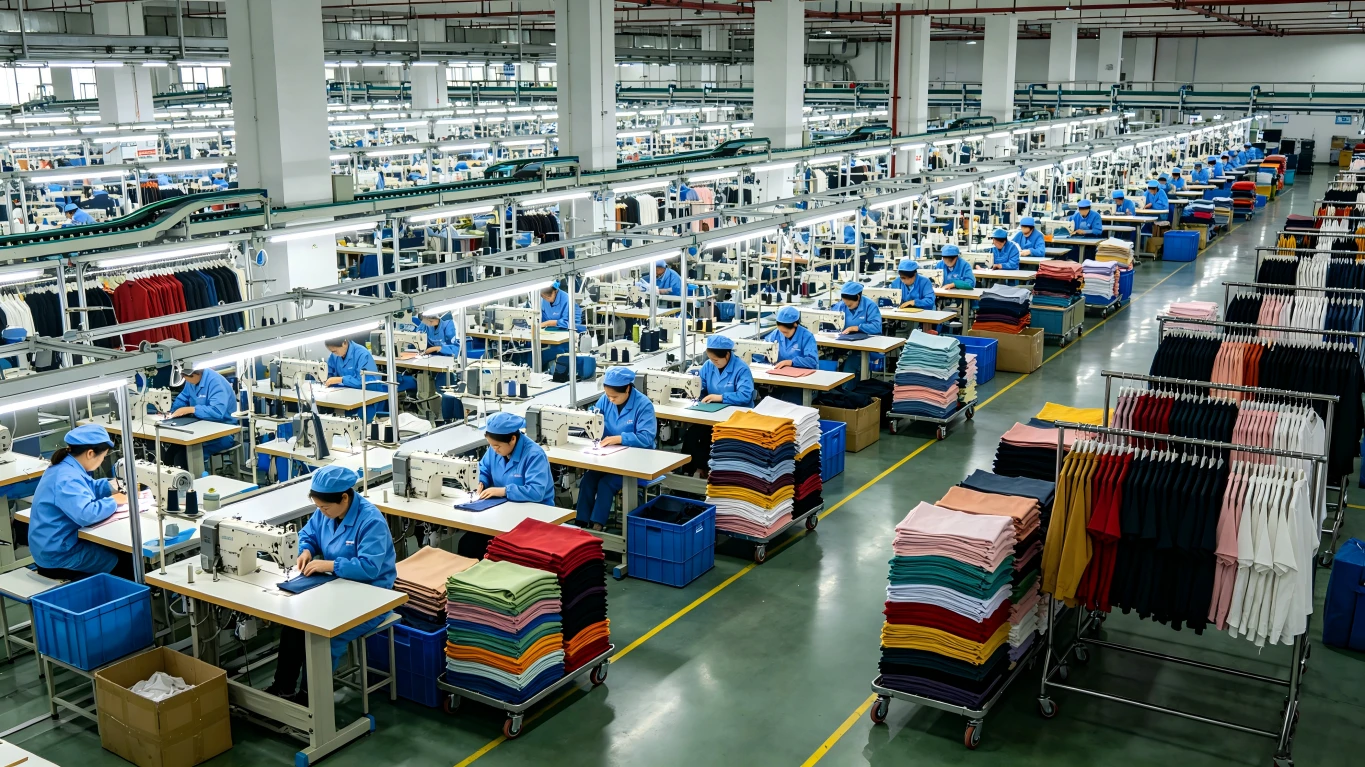
China's apparel industry is not organized by municipal boundaries. It is organized by industrial clusters — vast, interdependent networks of factories, dye houses, trim suppliers, and logistics hubs that can stretch across a 100-kilometer radius. When experienced buyers say "Guangzhou," they usually mean the entire Pearl River Delta manufacturing belt that includes Panyu, Zengcheng, Dongguan, and Zhongshan. When they say "Hangzhou," they are often referring to the Keqiao-Shaoxing textile corridor just thirty minutes away.
This distinction matters because most first-time buyers confuse wholesale markets with manufacturing centers. Baima, Shahe, and Shisanhang in Guangzhou are markets — places to spot trends, touch fabrics, and check what is selling. They are not factories. The actual OEM or ODM manufacturer is often a forty-five-minute drive away in a town you have never heard of. Understanding this difference is the first step to sourcing profitably.
A few terms you need to lock in before we continue:
OEM / ODM — OEM means the factory sews your existing designs. ODM means the factory offers design-ready collections you can rebrand.
MOQ (Minimum Order Quantity) — The smallest batch a factory will accept. In dense factory hubs like Guangzhou, competition drives MOQs down. In specialized hubs like Shanghai, factories can afford to be selective.
FOB (Free On Board) vs. EXW (Ex Works) — FOB means the supplier delivers goods to the port and clears export customs. EXW means you handle everything from the factory door. Port-proximate cities like Shenzhen make FOB cheaper and faster.
Golden Sample — The pre-production approval sample that becomes the quality benchmark for your entire order. Acceptance standards vary by city culture; Guangzhou factories move fast and may treat samples loosely, while Jiangsu factories treat the golden sample as a binding contract.
When sharing original designs with factories under OEM arrangements, protecting intellectual property China should be part of your initial agreement.
The State of China's Clothing Sourcing Landscape in 2026
According to China's General Administration of Customs, the country's textiles and garments export machine shipped roughly US$301 billion in 2024, with garments alone accounting for approximately US$159 billion. ASEAN, the United States, and the EU remained the core destinations. Despite macro headwinds and rising labor costs, China's role as the world's apparel hub is not diminishing — it is shifting.
Here is what has changed heading into 2026:
SHEIN and Temu supplier ecosystems have concentrated heavily in Guangzhou and Shenzhen, creating hyper-fast "test-and-scale" production models where a design can move from sketch to shipment in under seven days.
Sustainability certification demand is no longer optional for EU-bound brands. OEKO-TEX, GOTS, BCI cotton, and GRS certification density is highest in Zhejiang and Jiangsu provinces, making Hangzhou and Changshu increasingly attractive for compliance-focused buyers.
Labor cost divergence is accelerating. Coastal provinces like Guangdong and Jiangsu saw labor costs rise roughly 7% year-over-year. Inland hubs are gaining share for low-complexity basics, but export infrastructure and QC discipline still lag behind the coast.
Tariff and trade dynamics remain volatile. U.S. buyers currently face approximately 25% tariffs on Chinese apparel, forcing sharper costing models. EU buyers face stricter REACH and ESG documentation requirements.
The takeaway? A city that was the cheapest option in 2020 may now be expensive and under-automated. A city that was considered premium may now offer the best total cost of ownership when you factor in defect rates, certification access, and shipping reliability.
The Verdict: Best City to Source Clothes From China by Use Case
If you want a single answer, here it is: for roughly 70% of international buyers — including Amazon FBA sellers, boutique owners, wholesale distributors, and first-time importers — Guangzhou is the best city to source clothes from China. No other hub matches its combination of factory density, category breadth, export infrastructure, and price flexibility.
But Guangzhou is not universally optimal. The table below gives you the full picture.
City / Region | Best For | Typical MOQ | Price Tier | QC Difficulty | Export-Readiness |
|---|---|---|---|---|---|
Guangzhou | Fast fashion, denim, volume basics, accessories | 100–300 pcs/style | Low–Mid | Medium | Excellent |
Hangzhou | Silk, premium wovens, DTC e-commerce brands | 300–500 pcs/style | Mid–High | Medium-High | Very Good |
Shenzhen / Dongguan | Premium lingerie, streetwear, mass OEM, tech-integrated apparel | 200–500 pcs/style | Mid | Low-Medium | Excellent |
Fujian (Jinjiang / Quanzhou) | Sportswear, activewear, swimwear, athletic footwear | 500+ pcs/style | Mid | Medium | Good |
Shanghai / Jiangsu (Changshu / Suzhou) | Technical outerwear, tailored garments, luxury blends | 300–1,000 pcs/style | High | High | Excellent |
Shaoxing (Keqiao) | Custom fabric R&D, technical textiles, sustainable materials | Fabric MOQs vary | Varies | Medium | Good (fabric-focused) |
Use this table as your starting filter. The sections below give you the playbook for each city.
China's Top Clothing Sourcing Hubs by SpecialtyPrice tier, MOQ, and best use case at a glance GuangzhouFast fashion, denim, volume basics, accessoriesLow-MidMOQ: 100-300 pcs/style | Best for: FBA, boutiques HangzhouSilk, premium wovens, DTC e-commerce brandsMid-HighMOQ: 300-500 pcs/style | Best for: Premium brands Shenzhen / DongguanPremium lingerie, streetwear, mass OEM, tech apparelMidMOQ: 200-500 pcs/style | Best for: Large POs, OEM Fujian (Jinjiang)Sportswear, activewear, swimwear, athletic footwearMidMOQ: 500+ pcs/style | Best for: Athletic brands Shanghai / JiangsuTechnical outerwear, tailored garments, luxury blendsHighMOQ: 300-1,000 pcs/style | Best for: Luxury brands Shaoxing (Keqiao)Custom fabric R&D, technical textiles, sustainable materialsVariesFabric MOQs vary | Best for: Fabric-first design Quick Decision Guide → Chasing fast fashion or high volume? Choose Guangzhou → Building a premium or silk brand? Choose Hangzhou → Focused on sportswear or activewear? Choose Fujian → Need mass OEM with strict QC discipline? Choose Dongguan → Technical outerwear or tailored garments? Choose Shanghai / Jiangsu → Fabric innovation drives your design? Choose Shaoxing (Keqiao)
City-by-City Sourcing Playbook
Guangzhou — The Unbeatable Hub for Fast Fashion, Denim, and Volume
Guangzhou is not just a city. It is an ecosystem. Within a two-hour radius you have Zengcheng (the "Denim Capital of the World"), Baiyuan (accessories and trims), Panyu (knitwear and casual basics), and the wholesale market clusters of Baima, Shahe, and Shisanhang/Xinjie that serve as the trend radar for all of it.
For buyers who need flexibility, Guangzhou is unmatched. You can source fabric at Zhongda Fabric Market, find a trim supplier in Baiyuan, and have a factory in Panyu cut and sew the garment — all within the same day. For simple styles, design-to-production turnaround can be as fast as 48 hours, which is why cross-border e-commerce giants cluster here.
Price ranges at wholesale stall level look like this: T-shirts $0.75–$2.00, jeans $3.00–$6.00, dresses $2.50–$8.00. But here is what the stall prices do not show you: factory-direct OEM pricing at MOQ 300+ pieces is typically 15–25% lower than stall quotes, because you are removing the middleman.
The downside? Factory vetting difficulty is medium. The sheer size of the pool means a high ratio of trading companies posing as manufacturers, and language barriers are significant outside export-oriented districts. These sourcing communication challenges are why many buyers hire local support. You need a Supplier Verification process, not just a WeChat contact.
Logistically, Guangzhou is a dream. The Canton Fair happens here twice a year. Nansha and Shekou are among the world's busiest container ports. Typical FOB lead time from sample approval is 25–40 days.
SinoSourceAgent operates from Dongguan, within the Greater Guangzhou manufacturing belt. We bypass wholesale stalls entirely and route clients straight to audited factories in Panyu, Zengcheng, and Haizhu — eliminating the middleman markup and the guesswork.
Hangzhou — Silk, Premium Wovens, and E-Commerce-Ready Production
If Guangzhou is the volume king, Hangzhou is the quality and e-commerce queen. The city sits at the heart of Zhejiang province, home to Sijiqing (one of China's largest apparel wholesale districts) and just thirty minutes from Keqiao/Shaoxing, the largest textile trading hub in Asia.
Hangzhou factories excel at construction and finishing. A silk blouse or a woven dress from Hangzhou simply holds its shape better than a comparable garment from a budget-focused hub. The city is also deeply integrated with Alibaba's ecosystem, making it ideal for DTC brands that want data-driven design and rapid digital prototyping.
Price ranges run higher than Guangzhou for basics: cotton tees around 33 RMB, premium Korean-import styles around 100 RMB, and mulberry silk starting at 1,000+ RMB wholesale. The trade-off is consistency. Defect rates in Hangzhou's mid-to-high tier factories tend to be lower, which reduces your total cost of ownership even if the unit price is higher.
Factory vetting is medium-to-high difficulty. These factories are skilled but less accustomed to first-time foreign buyers. Many prioritize large domestic e-commerce clients and can be slow to respond to English inquiries.
Logistically, Ningbo-Zhoushan port handles EU-bound shipments efficiently. Hangzhou also leads China in OEKO-TEX and GOTS certification density, making it the safest choice for brands facing EU ESG compliance pressure.
We maintain active relationships with Hangzhou factories that typically refuse sub-500-piece orders directly. Our aggregated volume unlocks smaller MOQs for boutique clients without sacrificing construction quality.
Shenzhen & Dongguan — Premium Casual, Tech-Integrated Apparel, and Mass OEM
Shenzhen and Dongguan are often discussed separately, but for apparel buyers they function as a single mega-hub. Shenzhen's Nanyou district is China's leading center for designer-focused women's fashion and premium lingerie — the city controls roughly 80% of China's high-end lingerie market. Cross the border into Dongguan and you enter the world of mass OEM cut-and-sew, performance knits, and athleisure at scale.
Dongguan's export culture runs deep. Factories here are more likely to understand Western sizing standards, packaging requirements, and BSCI/WRAP audit expectations than factories in inland provinces. The city is also automating faster than any other apparel hub in China, which improves consistency for large, stable purchase orders — though it reduces flexibility for micro-orders.
Price ranges: Nanyou designer styles run 100–300 RMB. Dongguan OEM basics are comparable to Guangzhou but with stricter internal QC discipline.
Factory vetting difficulty is low-to-medium in Dongguan, medium in Shenzhen's Nanyou district (where Chinese language skills are essential for direct negotiation).
Logistically, this region is unbeatable. Hong Kong cargo airport plus Shenzhen Yantian port give you the fastest possible path from factory floor to freight departure. If you are shipping time-sensitive seasonal collections, this is your hub.
Our headquarters and deepest supplier network are in Dongguan. We know which factories have passed legitimate social audits and which ones merely downloaded a certificate template. That distinction has saved our clients from costly compliance surprises.
Fujian (Jinjiang & Quanzhou) — The Sportswear and Activewear Capital
If your product involves stretch, sweat, or swim, Fujian is not optional — it is essential. The province is home to Anta, Peak, and 361°, and the supplier ecosystem that grew around these brands has created unmatched expertise in functional knits, bonded seams, compression fabrics, and athletic footwear.
Price ranges at factory-direct levels: quick-dry sportswear $2.00–$5.00, knitwear $2.50–$6.00. The real value is not the price; it is the technical knowledge. A factory in Jinjiang understands moisture-wicking fabric blends and four-way stretch construction in a way that a generalist Guangzhou factory simply does not.
Factory vetting is medium difficulty. Vertical integration is common — many factories control yarn, knitting, dyeing, and finishing under one roof — which improves quality consistency but raises MOQs to 500+ pieces due to specialized equipment setups.
Logistically, Xiamen port is efficient but smaller than Shenzhen or Ningbo. Fujian works best for buyers who are category-focused (athletic wear) and can consolidate shipments rather than relying on rapid small-batch logistics.
We map the difference between "a factory that makes sportswear" and "a factory that understands compression ratios, bonded seam standards, and chlorine-resistant swimwear fabrics." That distinction is what prevents costly returns and negative reviews.
Shanghai / Jiangsu (Changshu, Suzhou) — Technical Outerwear and High-Fashion
This region represents the top tier of Chinese apparel manufacturing. Factories in Suzhou and Changshu produce technical outerwear — ski jackets, Gore-Tex shells, performance padding — and luxury-tailored garments for European, Japanese, and American brands that demand exacting standards.
These factories are selective. They vet you as much as you vet them. Expect longer courtship periods, higher MOQs (often 300–1,000 pieces), and prices that reflect genuine craftsmanship rather than commodity sewing.
Factory vetting difficulty is high, but not because of scams. These factories are legitimate and professional. The difficulty is gaining access and meeting their standards.
Logistically, Shanghai port and Pudong air freight are world-class. This region is ideal for high-value, low-volume shipments where unit margin justifies premium manufacturing.
For clients needing this tier, we handle the relationship-building phase — the guanxi — that Western buyers often underestimate. A cold email to a Changshu outerwear factory rarely works. A warm introduction from a trusted partner changes everything.
Shaoxing (Keqiao) — The Fabric Capital You Can't Ignore
Shaoxing is not a garment-sewing hub in the traditional sense. It is a fabric capital — the world's largest textile trading market, where you can develop custom chiffons, jacquards, recycled poly blends, and technical performance textiles before a single garment is cut.
If your design starts with the fabric, Keqiao should be your first stop, even if your garment sewing happens elsewhere. We often run parallel sourcing for clients: fabric R&D in Keqiao, garment production in Dongguan or Guangzhou. This optimizes both material innovation and unit cost.
Why Wholesale Markets Are Just the Starting Point
Here is a truth most guides will not tell you: the majority of stalls in Baima, Shahe, and Shisanhang do not manufacture anything. They buy from factories and resell with a 20–40% markup. When you source from a stall, you are paying tourist prices.
From Wholesale Market to Factory: The Sourcing Journey 1Visit MarketsSpot trends atBaima, Shahe,or SijiqingTrap: Stalls markup20-40% over factory 2Verify SupplierCheck businesslicense, factoryaddress, and labelsTrap: Trading co.posing as factory 3Factory AuditVirtual or on-sitevisit to confirmequipment & capacityTrap: Refuses videocall or site visit 4Place OrderApprove goldensample, confirmMOQ & IncotermsTrap: Vague specslead to wrong goods 5QC & ShipAQL 2.5 pre-shipment inspection,then FOB exportTrap: Skipping QCcosts 5-20% returns Pro Tip: The SinoSourceAgent DifferenceOur Dongguan-based team skips the market middlemen and routes clients directly to audited garment factories across Guangzhou,Hangzhou, and Fujian — cutting unit costs by 15-25% and eliminating the trading-company markup trap.
Moving from stall to factory requires three steps:
Check the garment labels for actual factory names and addresses.
Request a factory business license (营业执照) and verify it against Chinese corporate records.
Insist on a Factory Audit — virtual or in-person — before placing bulk orders.
One insider detail most buyers miss: factories often sew samples with higher-grade thread and fabric than they plan to use in bulk production. Always request a "production sample" made from the actual bulk material, not just the showroom golden sample.
Red flags that you are dealing with a middleman, not a manufacturer: a "factory" that refuses video calls; a supplier who cannot explain where their fabric comes from; prices that seem impossibly low for the claimed quality tier.
Before wiring any deposit, review safe payment China supplier practices to protect your funds.
This is exactly where an experienced Sourcing Agent becomes valuable — not to replace your judgment, but to verify what you cannot see from ten thousand miles away.
Quality Control & Compliance: What Changes by City
Every city in China has factories that claim to meet international standards. The difference is how easy it is to verify those claims.
Here is the garment-specific China product quality control framework we apply on every order:
Stage | What to Check | Common Failures by City |
|---|---|---|
Pre-production | Golden sample approval, fabric composition testing, colorfastness | Guangzhou: rushed samples that do not match bulk. Hangzhou: samples are accurate but expensive to revise. |
In-line inspection | Stitch density, seam alignment, pattern consistency | Dongguan: strong in-line discipline. Fujian: excellent on technical construction, weaker on casual finishing. |
Pre-shipment | AQL 2.5 random inspection, packaging integrity, carton drop tests | Budget hubs: high defect rates on zippers, buttons, and loose threads. Premium hubs: lower defect rates but slower to rework. |
AQL 2.5 means that in a random sample of your shipment, no more than 2.5% of units can contain major defects for the batch to pass. For apparel, major defects include visible stains, broken seams, incorrect sizing, and missing trims.
Compliance maturity by region: - Guangzhou / Dongguan: Broadest access to certifications (ISO 9001, BSCI, Sedex), but verification is entirely the buyer's responsibility. - Hangzhou / Jiangsu: Strongest sustainability infrastructure (OEKO-TEX, GOTS, GRS). Best for EU-bound brands. - Fujian: Excellent performance fabric certifications; social audit coverage is more uneven.
Destination market differences matter. EU buyers need REACH compliance and accurate care labels. US buyers face CPSIA rules for children's wear and roughly 25% tariffs that must be built into costing. UK buyers deal with post-Brexit customs complexity that makes door-to-door agent-managed logistics highly attractive.
The Real Cost of Sourcing: Beyond the Price Tag
If you evaluate sourcing decisions by unit cost alone, you will lose money. The real metric is Total Cost of Ownership (TCO):
Cost Component | Typical Range | Who Underestimates It |
|---|---|---|
Unit cost (FOB / EXW) | Varies by city and category | Everyone tracks this; it is the easy part. |
Sampling & prototyping | $200–$800 per style | First-time buyers who assume samples are free. |
Third-party inspection | $250–$500 per inspection | Buyers who trust factory self-inspection. |
Shipping & customs | Sea: $50–$200/CBM; Air: $4–$8/kg | Buyers who forget to factor in Incoterms differences. |
Defects & returns | 5–20% of order value for unvetted suppliers | The silent killer that turns a "cheap" order into a loss. |
A Hangzhou factory with a 10% higher unit cost but a 2% defect rate often beats an ultra-cheap, unvetted source with a 15% defect rate and no export infrastructure. The math is not complicated, but it requires looking past the sticker price.
In 2024, a U.S. DTC apparel brand we work with switched from an unvetted Guangzhou stall supplier to an audited Panyu factory through our network. Unit cost rose 8%, but defect rates dropped from 14% to under 3%. Their return rate fell by half, and they recouped the higher unit cost within the first reorder.
Be especially wary of guides that promote $0.75 T-shirts without warning about MOQ traps, tail-goods quality variance, and zero return policies. These are classic importing from China mistakes that turn a "cheap" order into a total loss. That price is real, but the risk is not always disclosed.
Disclaimer: Pricing figures, MOQs, and lead times cited in this guide are based on our direct sourcing experience and market observations as of 2026. Actual factory terms vary by season, order volume, and material costs. Always verify current pricing and compliance requirements with your supplier before placing orders.
How to Visit China's Clothing Hubs: A Practical Guide for Foreign Buyers
If you are planning a sourcing trip, logistics matter as much as factory selection.
Timing: Apply for a 10-year China business visa (M visa) if you plan to visit regularly. Avoid January and February (Chinese New Year shutdown). The best windows are March–April (post-Canton Fair) and September–October (pre-holiday production season).
Where to stay: - Guangzhou: Yuexiu District near Guangzhou Railway Station puts you within walking distance of Baima and Shisanhang. - Hangzhou: Jianggan District near Sijiqing saves you an hour of commute each morning.
Language & payments: Download and verify WeChat Pay and Alipay before arrival — most stalls do not accept foreign cards. A bilingual sourcing agent saves most buyers three to four days per trip by handling negotiation, translation, and supplier qualification in real time.
Market navigation tips: Arrive before 9 AM. Bring cash as backup. Photograph every stall number and business card. And never — never — place a bulk order on your first visit.
Shipping consolidation: If you buy from multiple Guangzhou markets, you need a consolidation warehouse to combine everything into a single FOB shipment. Most freight forwarders will not explain this until you have already overpaid for separate small shipments.
Do You Need a Clothing Sourcing Agent in China?
Let me be direct. If you speak fluent Mandarin, have thirty-plus days a year to spend in China, and genuinely enjoy negotiating in 40-degree warehouse heat, you might not need an agent. Everyone else should consider one.
An agent does five things that are difficult to replicate remotely:
Supplier identification beyond Alibaba/1688 — The best factories are often not on B2B platforms.
China factory audit — In-person or virtual verification of licenses, equipment, and working conditions.
Quality control services — Independent inspection reports delivered directly to you, not filtered by the factory.
Price negotiation — Using local market knowledge to benchmark true factory pricing.
Logistics consolidation — Combining orders, managing customs documentation, and optimizing shipping.
At SinoSourceAgent, we have spent ten years building this infrastructure from our base in Dongguan. Our differences from a typical remote broker are concrete: thousands of vetted suppliers across every major apparel hub; an independent QC team that reports to you first; end-to-end transparent quoting with no hidden middleman fees; and a bilingual team that bridges specification, timeline, and cultural gaps before they become expensive misunderstandings. Every factory in our network has passed a documented on-site audit, and clients can review those audit reports before placing a single order.
Whether you choose Guangzhou, Hangzhou, or Fujian, the factory you select within that city matters more than the city itself. That is where a grounded supplier network becomes your advantage.
Frequently Asked Questions
What is the best city to source clothes from China for beginners? Guangzhou. The factory density, English-speaking export culture, and logistics infrastructure make it the most forgiving hub for first-time buyers — provided you have a vetting process and do not rely solely on wholesale stall prices.
What is the typical MOQ for clothing factories in China? It varies by city and factory tier. Guangzhou and Dongguan can go as low as 100–300 pieces per style for basic garments. Hangzhou and Shanghai typically expect 300–1,000 pieces. Specialized sportswear factories in Fujian often require 500+ pieces due to equipment setup costs.
Guangzhou vs Hangzhou for clothing sourcing — which wins? Guangzhou wins on price, speed, and flexibility. Hangzhou wins on construction quality, silk/premium wovens, and sustainability certification access. For general apparel and fast fashion, choose Guangzhou. For premium positioning or EU compliance, choose Hangzhou.
Can I buy cheap wholesale clothing from China without speaking Chinese? Yes, but with limits. English-friendly platforms like Made-in-China and Kakaclo work for small orders. For 1688 (Chinese-only) or direct factory negotiation, you will need a translator or agent. Prices are often better when you can negotiate in Chinese.
How do I verify a Chinese clothing supplier is legitimate and not a trading company? Request a factory business license, ask for a video factory tour, check if they can explain their fabric sourcing and production process, and verify their address on Chinese corporate databases. A legitimate manufacturer will welcome scrutiny. A trading company will dodge it.
What's the cheapest shipping method for wholesale clothing from China?Sea freight is cheapest for large volumes, typically $50–$200 per cubic meter with a 3–6 week transit time. Air freight is faster but significantly more expensive. For small e-commerce test batches, express courier may be cost-competitive.
Which city is best for sustainable/ethical clothing manufacturing in China? Hangzhou and the broader Jiangsu/Zhejiang region lead in OEKO-TEX, GOTS, BCI, and GRS certification density. Dongguan and Guangzhou have growing sustainable options but require more active verification.
How long does it take from sample approval to shipment for apparel orders? Typically 25–40 days for standard garments from Guangzhou or Dongguan. Complex technical outerwear from Shanghai/Jiangsu can take 45–60 days. Rush orders in Guangzhou can compress to 2–3 weeks for simple styles, but quality risk rises accordingly.
Should I choose FOB, EXW, or let my agent handle door-to-door logistics?FOB is the safest default for buyers who have a freight forwarder. EXW saves the supplier effort but puts all logistics burden on you. Door-to-door (DDP) through an agent is the simplest option for buyers who want to focus on selling, not shipping paperwork.
Can I source clothing from China for Amazon FBA, and which city is best? Yes. Guangzhou and Dongguan are the best cities for Amazon FBA sellers because of low MOQs, fast turnaround, established packaging-for-FBA standards, and deep experience with U.S. labeling and compliance requirements. Working with a dedicated Amazon FBA sourcing agent can further streamline product vetting and FBA inbound prep.
Conclusion: Your Next Step
Guangzhou offers the most flexibility for general apparel and fast fashion. Hangzhou wins for silk, premium wovens, and e-commerce-ready production. Fujian dominates sportswear and activewear. Dongguan delivers mass OEM scale with export discipline and the best logistics access. Shaoxing is non-negotiable if fabric innovation drives your design.
But remember this: the best city is only the beginning. The best factory within that city — vetted, audited, and managed with clear QC protocols — is what ultimately determines your profit margin and brand reputation.
At SinoSourceAgent, we eliminate the guesswork from sourcing products from china. Our team operates from Dongguan with active networks across Guangzhou, Hangzhou, Shenzhen, and Fujian. We do not just tell you which city to choose — we find, audit, and manage the right factory for your specific product.
Get a free supplier shortlist tailored to your apparel category and target price point. Contact us at +8613652665703 or visit SinoSourceAgent to start your sourcing journey with a partner who has been on the factory floor for over a decade.